Still Wetting the Bed at 10. At 13. At 15.
Mama Adunola's 21-Night Protocol for Nigerian Mothers Who Have Tried Everything — The Last System You Will Ever Need
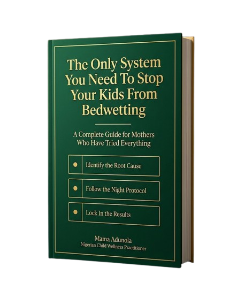
You Have Been Changing Those Sheets For Years.
It Is Time for It to Stop.
This 21-night home protocol has helped over 2,000 Nigerian mothers end persistent bedwetting in children and teenagers aged 6–15 — without drugs, without punishment, and without one more morning of silent heartbreak.
Built entirely around Nigerian households. Nigerian foods. Nigerian mothers. It was made for you.
Download Now for ₦8,500 →You Do Not Need Me to Explain
What Your Mornings Look Like.
You are already awake before him. You walk toward his room the same way every day — not with hope anymore, but with that low, braced feeling you have learned to carry. You smell it before you open the door sometimes. You have stripped that mattress so many times that your hands move on their own now.
You have a system. Extra sheet folded underneath. Mattress protector. A specific pile in the corner of the bathroom that you deal with quietly before the rest of the house wakes up. Nobody else does this. It is always you.
And when it is done — when the sheets are in the machine and your child is at the sink not quite meeting your eyes — you say something reassuring. Something calm. Because you have learned that your reaction in those first 90 seconds sets the tone for his entire day.
So you hold it together. Every single morning, you hold it together.
But you are exhausted. Not just from the laundry. From the management of it. From the school trip announcements that make your stomach drop. From the cousin's birthday sleepover you had to quietly decline. From your mother-in-law's eyes that time she noticed the mattress protector. From your husband who said — for the third time — "the boy just needs to stop."
I need you to hear this clearly:
It will stop. And it will stop on a schedule. Starting tonight.
You Did Not Fail Him.
You Had the Wrong System.
Let me tell you what you have already tried. Because I know.
- Waking him at midnight. It worked for two nights. Then he was too groggy to wake properly — and it started making the bedwetting happen earlier.
- Restricting water after 6pm. You watched him go to bed thirsty. It made absolutely no difference whatsoever.
- Punishment and stern words. It made him cry. It made you feel terrible. And the bed was still wet the next morning.
- The herbal mixture your aunt or someone at church recommended. You gave it faithfully for weeks. Nothing changed.
- Prayer. God hears mothers. But sometimes the answer comes through knowledge, not supplication alone.
- The doctor. He told you the child would "grow out of it." Sent you home with nothing. As if you have years more of wet mornings to simply absorb.
None of it worked — not because you are a bad mother, not because your child is broken.
It did not work because every single approach was addressing the wrong cause.
The Three Hidden Causes Keeping
Your Child's Bed Wet
After 14 years of working with Nigerian mothers and studying both traditional remedies and modern child health research, Mama Adunola identified three specific causes that drive persistent bedwetting. Most doctors address none of them. All three must be addressed together. That is why partial solutions produce partial results.
The Nigerian Diet Trigger
There is a specific reaction in children with developing bladders when they consume high quantities of fermented and high-pepper ingredients — stockfish, ogiri, uziza, Maggi-heavy stews — particularly in the window between 3pm and 7pm. This reaction increases nighttime urine production significantly.
This is not about removing your child from Nigerian food culture. It is about timing, quantity, and specific substitutions during the 21 nights that require almost no disruption to your household.
An Undertrained Bladder
Most parents try to reduce fluids in the evening. This is instinctively logical and completely backwards. Bladder capacity is built through controlled fluid loading during the day — teaching the bladder to hold progressively more before signalling release.
A child whose bladder has never been trained this way has a functional capacity far below his age level. At night, his undertrained bladder fills and empties before his brain has any chance to respond. The protocol includes a specific daytime training sequence that builds real capacity from Night 1.
The Arousal Disconnect
In a child without bedwetting, the brain and bladder communicate constantly during sleep. When the bladder reaches capacity, a signal travels to the brain, the brain registers it, and the child either wakes or suppresses urination until morning.
In a bedwetting child — especially a deep sleeper — this communication pathway is underdeveloped. The signal travels. The brain does not register it. The bladder empties. The 7-minute pre-sleep routine at the centre of this protocol is specifically designed to begin rebuilding this brain-bladder communication through a sequence of cues done at the same time, in the same order, every night.
Here Is Everything Inside
The 21-Night Protocol
The Wet Night Audit
Before you begin Night 1, you need to know which bedwetting profile your child falls into — the Deep Sleeper, the Small Bladder, or the Trigger Child. Each profile responds differently and at different speeds. This diagnostic tool tells you exactly which profile you are working with and what to prioritise. You will feel the difference between generic advice and a system built around your specific child within the first five minutes.
Section One — Why Your Child Is Not Doing This On Purpose
This section explains, in plain language, exactly what is happening inside your child's brain and bladder while he sleeps. When you finish this section you will never interpret a wet morning as failure again — not his, and not yours. You will understand what you are actually dealing with. And that understanding will make everything that follows work faster.
Section Two — The Three Hidden Causes Most Doctors Miss
The full, detailed breakdown of the dietary trigger, the undertrained bladder, and the arousal disconnect — with specific action steps for each. This is the section that will make you realise why nothing has worked until now. It is also the section that Nigerian mothers share with their sisters and friends, because the information in it is genuinely not available anywhere else in this form.
The Nigerian Trigger Foods Checklist
Every food in a typical Nigerian household assessed and categorised into three columns — High Risk, Moderate Risk, and Safe. Eba. Pounded yam. Ogiri. Stockfish. Indomie. Milo. Fanta. Akara. Pepper soup. Chin chin. All of it assessed. No guessing. No Western food list with two Nigerian foods awkwardly inserted. This was built for your kitchen. Print it and put it on your wall.
Section Three — The Complete 21-Night Protocol
Three phases of seven nights each — Reset, Build, and Lock — with a clear daily structure for every single night. Morning routine. Fluid schedule. Evening meal guidance. The 7-minute pre-sleep sequence. What to expect at each phase. How to read your child's progress. What dry nights feel like when they first appear and how to protect them. What to do when a wet night returns after a dry streak. This is not a pamphlet. This is a complete operating system for the next 21 nights.
The 21-Night Dry Bed Tracking Chart
A printable chart designed for the child to fill in himself — warm, not clinical, not childish. A star for a dry night. A small cloud for a wet one. No shame language anywhere. This tool makes your child a participant in his own healing rather than a problem being managed. Mothers consistently report that children become more cooperative and more motivated once they are holding the pen themselves.
Section Four — The Morning Reset
What to say — and what never to say — in the first 90 seconds after a wet night. A word-for-word script for the hardest mornings. How to manage your husband's comments. How to deflect your mother-in-law. How to handle school trip situations while the protocol is running. And a short, honest section for the night — probably around Night 14 — when you are tired and doubting and need someone to remind you what you are actually doing.
Doctor Conversation Guide + Quick-Start Reference
The Doctor Guide is a single printable page to bring to any medical appointment — with the correct clinical terms, the three questions most parents never think to ask, and what to push for if the doctor dismisses you too quickly. The Quick-Start Reference is one page, three columns: Tonight, This Week, and The One Thing. For the mother who bought this at midnight and needs to start right now.
What Nigerian Mothers
Are Saying
"My son Chukwuemeka was 13 years old and still wetting the bed. I was so ashamed I had not told anyone — not even my sister. I found this protocol at midnight on a Thursday. By Night 11 we had our first dry morning. He cried. I cried. We have not looked back. He went on his first school trip last month and I did not panic once."
"I almost did not buy this because I have wasted money on so many things that did not work. What made me try was the part about Nigerian foods. Nobody had ever mentioned that to me before. My daughter is 10 and within three weeks her wet nights went from every night to twice in the entire third week."
"My husband thought I was wasting money. He said our son would grow out of it. Our son was 14. I bought the protocol anyway. Night 17 was the first completely dry night. Night 18. Night 19. My husband has not said anything but he stopped making his comments. That is enough for me."
"We are in London and I was worried this would not apply to us because of the food differences. But the protocol addressed everything — it even accounted for the foods we still cook at home. My son is 11. We finished the 21 nights two weeks ago. The bed has been dry every single morning."
"What changed everything was the tracking chart. Once my son started filling it in himself — once he became part of it — everything shifted. He started reminding ME about the pre-sleep routine. He wanted the star. By Night 13 he had four stars in a row. Last weekend he asked to sleep at his friend's house. He came home dry."
Where This Protocol Came From
Mama Adunola is not a doctor. She is something older than that.
She is the woman your grandmother would have sent you to. The one in every Nigerian compound, in every village, in every community who knew things — not from textbooks but from watching, from listening, from decades of sitting with mothers who came to her at the end of their rope.
She began collecting what she knew about bedwetting in children the way her own mother had taught her — by paying attention. By noticing which children stopped and which ones did not. By asking what they ate, how they slept, what their evenings looked like, what their mothers said to them in the morning.
Over fourteen years she refined what she noticed into something repeatable. Something teachable. She tested it in her own community. She shared it with mothers who shared it with their sisters. She adjusted it when something did not work and kept what consistently did.
What you are holding is the result of those fourteen years — finally written down, finally structured, finally available to every Nigerian mother who is lying awake at midnight wondering if this will ever end.
She wrote it for you. For the mother in Abuja stripping sheets before sunrise. For the mother in London managing the school trip panic. For the mother in Enugu whose 15-year-old has stopped telling her friends he exists.
This Protocol Is Exactly For You If...
Your child is between 6 and 15 years old and is still wetting the bed regularly
You have already tried restricting water, midnight wake-ups, and punishment — and nothing worked
Your child avoids sleepovers, school trips, and cousins' houses because of the secret he carries
You cook Nigerian food at home and want a protocol built for your actual household — not a Western pamphlet
A doctor has told you to "wait for him to grow out of it" and you are done accepting that answer
You are in Nigeria, the UK, the US, or Canada and need something that works in your real life
This is not for you if your child is under 5 — bedwetting at that age is entirely normal and no protocol is needed
This is not for you if you are looking for a magic pill or a one-night fix — this is a 21-night system that requires consistent follow-through
Everything You Are
Wondering Right Now
Everything You Need to End This. Tonight.
Complete instant download — works on any phone, tablet, or computer
- The complete Mama Adunola 21-Night Dry Bed Protocol — all five sections
- Tool #1 — The Wet Night Audit
- Tool #2 — The Nigerian Trigger Foods Checklist
- Tool #3 — The 21-Night Dry Bed Tracking Chart
- Tool #4 — The Doctor Conversation Guide
- Tool #5 — The Quick-Start One-Page Reference
🔒 Secure payment · Instant PDF download · Works on all devices
Your Risk Is Zero. His Dry Mornings Are Not.
Try the complete protocol for 14 nights. Follow the system. Use the tools. If you do not see measurable progress — fewer wet nights, longer dry stretches — send one message and receive a complete refund. No questions. No forms. No waiting. This guarantee exists because the protocol works.
He Has Carried This
Long Enough.
Right now — tonight — there is a child in your house who went to sleep hoping tomorrow morning will be different. He has never said that to you. But you know it is true because you see the way he holds his breath for that one second between waking up and knowing.
He is not broken. He is waiting for the right system. In 21 nights from tonight, that child can walk to school knowing something about himself he has never known before — that his body works. That he is not different. That the thing that has been following him since primary school is finally, completely, over.
He deserves that morning. And after everything you have carried — every sheet, every quiet 6am, every reassurance you gave him when you were not feeling it yourself — you deserve to be the mother who gave it to him.
YES — Download the Protocol Now for ₦8,500